The Stochastic Oscillator is one of those tools almost every MetaTrader trader has used, but very few use well. Most people treat it like a traffic light. Above 80 means sell. Below 20 means buy. Then they wonder why they keep getting trapped by trends that stay stretched far longer than expected. The issue is not the Stochastic itself. The issue is timing. If you only react after the turn is obvious, your entry is usually late, your stop is wider, and your confidence disappears the second price hesitates.
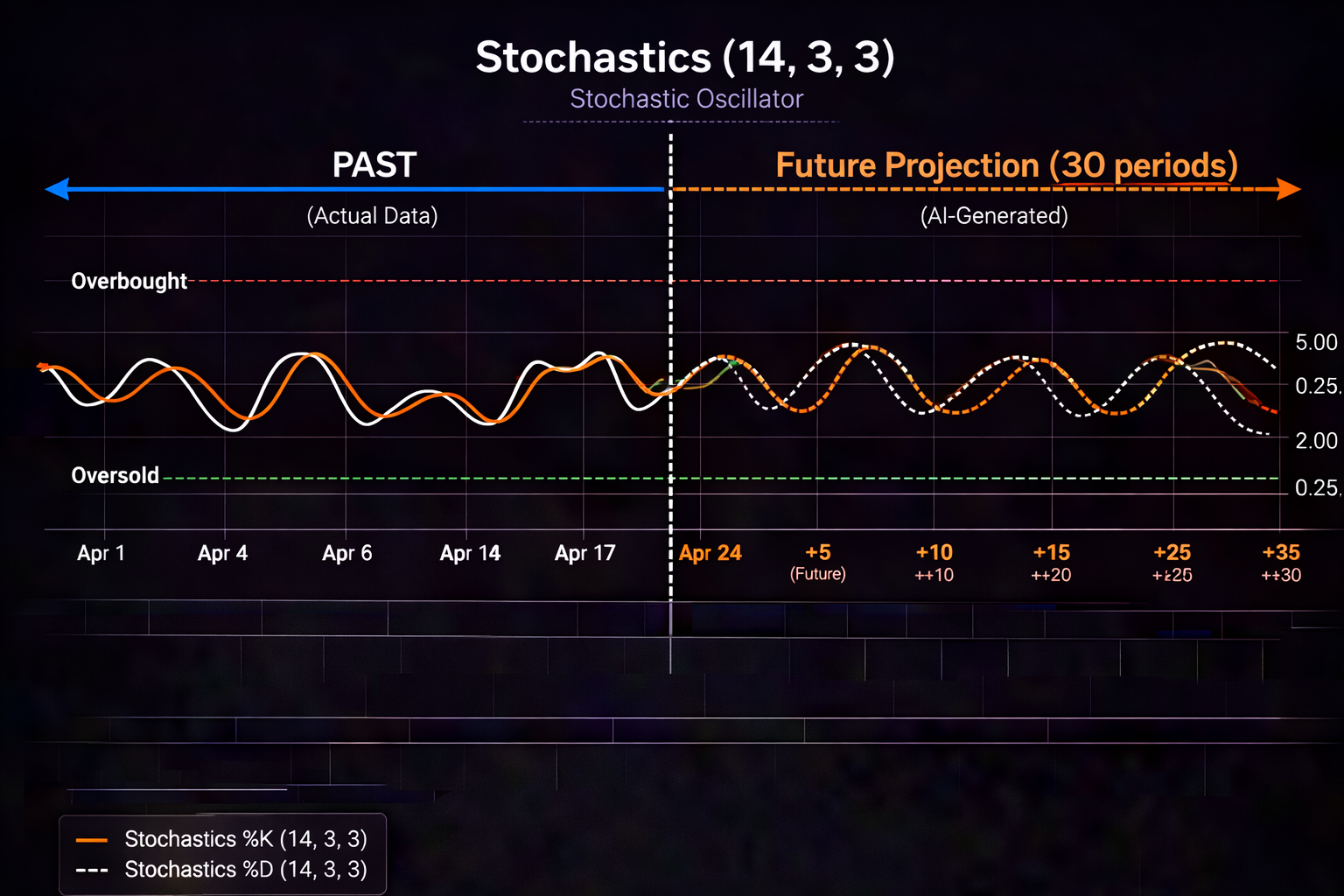
AI-predicted overbought and oversold conditions
A MetaTrader stochastic predictor changes that workflow. Instead of using Stochastic as a rear-view mirror, you use it as an early warning layer for momentum exhaustion, continuation, and reversal quality. That matters whether you trade forex, indices, gold, or crypto on MetaTrader 5. The Stochastic still helps you read where momentum sits inside the recent range. What traders actually need, though, is a better read on where that momentum is likely heading next.
That is where PredictIndicators.ai fits. It helps traders forecast where key indicators such as Stochastics, MACD, ATR, directional movement, Wiseman tools, and candlestick structure are heading up to 30 bars ahead. On MetaTrader 5, that can give you a much cleaner way to judge whether an oversold reading is becoming a real reversal, whether an overbought trend still has fuel, and whether a pullback is likely to reset or roll over. In this guide, I’ll show you how a stochastic predictor improves MetaTrader decision-making, where it helps most, and what mistakes still ruin otherwise good setups.
Why MetaTrader Traders Keep Coming Back to Stochastic
There is a reason Stochastic never disappears from serious charting platforms. It is simple, visual, and useful across multiple market conditions. On MetaTrader 5, that makes it popular with swing traders, intraday traders, and even position traders who want a quick way to judge whether momentum is expanding or fading inside a known range.
At its core, the Stochastic measures where the current close sits relative to the recent high-low range. That tells you whether buyers are consistently pushing closes near the highs or whether sellers are forcing closes near the lows. Used properly, it is not a random oscillator. It is a fast read on the quality of momentum.
- Range traders use it to spot potential reversals at support and resistance.
- Trend traders use it to time pullback re-entry without guessing blindly.
- Forex traders use it to filter noisy sessions and identify cleaner continuation swings.
- Swing traders use it to judge when a move is maturing and partials or tighter management make sense.
The problem is not that traders misunderstand how to read 80 and 20. The problem is that they think those numbers are enough by themselves. Markets do not reverse just because the oscillator says they are stretched. Trends can stay stretched. Weak bounces can still fail. A forward-looking process is what separates the Stochastic from a toy indicator.
Important: Overbought and oversold are context signals, not automatic trade triggers. On MetaTrader, the traders who get paid are the ones who combine oscillator readings with structure, trend, and momentum quality.
What a MetaTrader Stochastic Predictor Actually Tells You
A MetaTrader stochastic predictor helps answer the questions regular Stochastic readings answer too late. Instead of looking only at where the oscillator has already moved, you can evaluate the projected path of that momentum if current price structure keeps building. That matters because most bad entries come from the same problem: the trader sees what just happened and assumes it will immediately continue or reverse.
With a projected Stochastic path, you can make better judgments around:
- whether an oversold reading is likely to become a meaningful turn or just a weak pause in a downtrend,
- whether an overbought trend still has room or is starting to flatten,
- whether a pullback is maturing into a continuation setup,
- and whether a divergence idea has real momentum support behind it.
That is especially valuable on MetaTrader 5 because many traders there operate across multiple symbols and timeframes at once. They do not need more signals. They need better filtering. PredictIndicators.ai for MetaTrader gives traders that forward-looking layer while also working across NinjaTrader 8, iPhone, Android, iPad, Mac, and the web app for traders who move between devices.
Use Stochastic With Better Timing
PredictIndicators.ai forecasts Stochastics and other core indicators up to 30 bars ahead so MetaTrader traders can filter weak reversals and time better entries across desktop and mobile.
Start Free →Three MetaTrader Setups That Improve Most With a Stochastic Predictor
1. Pullback Entries in a Strong Trend
This is one of the cleanest uses. Price trends higher, then retraces into an area you already care about such as a prior breakout level, moving average, session VWAP, or obvious support zone. Standard Stochastic often reaches oversold after price has already bounced enough to make the entry awkward. A projected Stochastic path helps you judge whether momentum is likely to stabilize and turn before the move becomes obvious to everyone else.
If projected Stochastic keeps weakening while price is pulling back, you may simply be buying too early. If projected Stochastic begins turning up while price is still holding a valid trend area, the long setup becomes much easier to justify. The same logic works in reverse for bearish pullback entries.
2. Range Reversal Filtering
Traders love range reversals because the reward-to-risk can look great, but ranges punish people who cannot tell the difference between a likely turn and a random pause. On MetaTrader, a Stochastic reading below 20 at support is not enough. If projected momentum still looks heavy, you may just be trying to catch a falling knife one bar too soon.
Using a stochastic predictor helps you filter for range trades where momentum is actually flattening and preparing to rotate. You still need the level. You still need a clean invalidation point. But you stop treating every oversold print as if it deserves your money.
3. Divergence Trades With Better Confirmation
Divergence is one of the most attractive Stochastic setups, but it is also one of the easiest to misuse. Traders see price print a new low while Stochastic holds a higher low and they jump in immediately. The result is often one more flush lower before the true turn begins. A projected Stochastic path can help you decide whether that divergence is starting to matter now or is still too early.
For MetaTrader swing traders, this is useful on higher timeframes where one bad early entry can mean a much larger stop. If price is pressing into a key level and projected Stochastic is starting to stabilize rather than continue collapsing, the divergence has more weight. If projected momentum still looks weak, patience usually pays better than hero entries.
How to Build a Better MetaTrader Workflow Around It
The traders who get the most from a stochastic predictor use it inside a repeatable process. They do not stare at the oscillator and improvise. A practical MetaTrader 5 workflow looks like this:
- Mark structure first. Support, resistance, trend channels, and session levels still come first.
- Choose the setup type. Pullback continuation, range reversal, or divergence. Do not mix all three without a plan.
- Read current Stochastic state. Is momentum stretched, neutral, or already turning?
- Check projected Stochastic direction. Is momentum likely improving, stalling, or still deteriorating?
- Confirm with price behavior. Candle structure, reclaim of a level, failed breakdown, or trend resumption still matters.
- Define invalidation before entry. The predictor improves timing; it does not remove risk.
This makes the tool useful instead of addictive. It becomes a filter, not a gambling excuse. That distinction matters. Retail traders often wreck good tools by expecting them to do the work of a full strategy. They never will.
| Decision Point | Reactive Stochastic Workflow | Forward-Looking Workflow |
|---|---|---|
| Oversold reversal | Buy because Stochastic hit 20 | Wait for projected momentum to stabilize into the level |
| Trend pullback | Enter after the bounce is obvious | Use projected turn to improve timing near structure |
| Divergence setup | Fade immediately on divergence | Check whether projected momentum supports the turn |
| Trade management | Exit only after momentum visibly fails | Prepare earlier when projected momentum starts flattening |
Common Mistakes Traders Make With Stochastic on MetaTrader
Mistake one: treating every 80 or 20 print like a command. In a strong trend, Stochastic can stay extreme for a long time. Selling an uptrend just because the oscillator is overbought is one of the fastest ways to bleed money slowly.
Mistake two: ignoring trend context. A beautiful bullish crossover in a hard downtrend is usually just a bounce until proven otherwise. Traders who use Stochastic without structure get chopped repeatedly.
Mistake three: entering on divergence without confirmation. Divergence is a warning, not an entry by itself. Projected momentum, reclaim of a level, or a better reversal pattern still matters.
Mistake four: overloading the chart. If you stack Stochastic, RSI, MACD, and three moving averages without a decision framework, you do not have more clarity. You have more excuses. A better approach is fewer tools, used with more discipline.
Mistake five: forgetting trade management. Even a strong projected turn can fail. News, liquidity shifts, and correlated market moves can invalidate a setup instantly. Position sizing and stop placement still matter more than any single indicator reading.
Why Cross-Platform Access Helps MetaTrader Traders
Even dedicated MetaTrader traders rarely stay glued to one desktop all day. You might scan symbols on your main workstation, manage open positions from your phone, review setups on a tablet at night, and do quick analysis from a browser when traveling. That is why cross-platform access matters more than many traders admit.
PredictIndicators.ai supports MetaTrader desktop workflows while also keeping the same forecasting logic available on iPhone, Android, iPad, Mac, and the web app. That consistency helps traders avoid the usual split-brain problem where desktop plans are forgotten the second they switch devices. If your trade idea was built around momentum improving into a level, you want that exact logic visible when you monitor it from mobile too.
Who Should Use a MetaTrader Stochastic Predictor?
This kind of tool is most useful for traders who already understand chart structure and want better anticipation. If your biggest weakness is late entries, weak reversal selection, or overtrading noisy oscillator signals, a MetaTrader stochastic predictor can tighten your process quickly. If your main problem is random execution, oversized risk, or no review discipline, the tool will not fix that. It may only make a bad process look more advanced.
The right user is the trader who wants to move from reaction to preparation. Instead of waiting for the market to confirm everything after the move is underway, you build a better read on whether momentum is likely to improve, stall, or fail before you commit. That is exactly why more traders are using PredictIndicators.ai as part of their MetaTrader routine. It helps you see the quality of a Stochastic setup earlier and act with more structure instead of more emotion.
Stop Waiting for Stochastic to Turn After the Opportunity
PredictIndicators.ai helps MetaTrader traders anticipate where Stochastics and other core indicators are heading so entries, exits, and filters become cleaner across MT5, mobile, Mac, and web.
Try PredictIndicators.ai →