MetaTrader 5 Day Trading Guide: Expert Strategies for Retail Traders
By Robert · March 11, 2026 · Day Trading · 12 min read
Day trading on MetaTrader 5 has become the go-to approach for retail traders who want to capitalize on intraday price movements. MT5 offers the speed, tools, and flexibility that day traders need — but having the platform is only half the battle. The real edge comes from knowing which strategies actually work, how to manage risk when you're in and out of trades within hours, and when to use AI-powered prediction to see what's coming before the crowd reacts.
I've spent years trading on MT5, and I've learned that day trading success isn't about finding a magic indicator or secret strategy. It's about building a repeatable process: a setup that fits your schedule, risk rules you can stick to under pressure, and tools that give you conviction before you hit the buy button. This guide walks through everything — from platform setup to advanced strategies enhanced with AI prediction — so you can trade with clarity instead of chaos.
Whether you're brand new to day trading or you've been grinding MT5 for a while and hitting walls, this guide gives you the framework to trade smaller, faster, and smarter. Let's build your day trading system from the ground up.
Why MetaTrader 5 for Day Trading?
MetaTrader 5 wasn't built specifically for day traders, but it's become the platform of choice for intraday trading for good reasons. Here's what makes MT5 stand out for day trading versus its predecessors and competitors:
21 timeframes — from 1-minute charts for scalping to monthly for context. Most day traders live on M1, M5, M15, and H1.
Depth of Market (DOM) — see real-time order book depth. Critical for understanding liquidity before entries.
One-click trading — execute trades instantly from charts. When you spot a setup, seconds matter.
Economic calendar built-in — no need to tab out to ForexFactory. News events are visible inside MT5.
Multiple asset classes — forex, stocks, indices, commodities, crypto. Day traders can diversify or focus on their best market.
Expert Advisors (EAs) — automate strategies if you want to remove emotion or test systems systematically.
Advanced order types — buy stop, sell stop, buy limit, sell limit, stop-loss, take-profit, trailing stops. Full control over entry and exit.
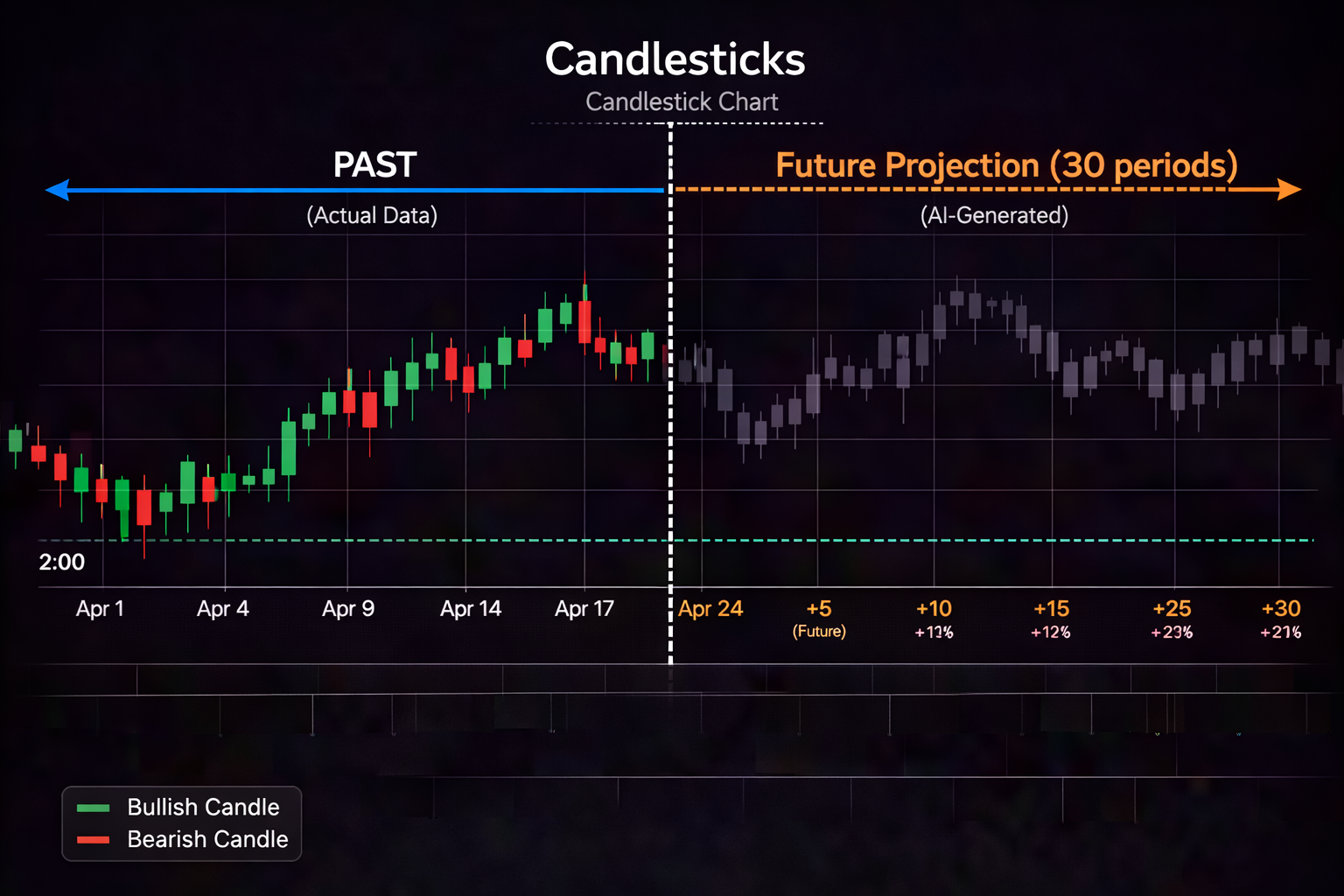
But here's the reality: MT5 gives you the tools, not the edge. The platform is fast and flexible, but every indicator on MT5 is lagging — it tells you what already happened. That's where prediction changes the game. When you can see where MACD, Stochastics, or ATR are heading 30 bars ahead, you're not reacting to crosses and bounces — you're positioning before they occur.
💡 Reality Check
MT5 is a tool, not a strategy. The platform won't make you profitable. Your edge comes from your process, risk management, and knowing when confluence aligns. AI prediction adds a layer of foresight, but discipline still wins.
Setting Up MT5 for Day Trading
Your MT5 workspace determines your trading speed. Cluttered charts, scattered windows, and slow execution kill day trading performance. Here's how to set up MT5 for intraday trading:
1. Chart Layout for Day Trading
Day traders need to see price action clearly without indicator clutter. Follow this layout:
Primary chart: Candlestick or bar chart on your main timeframe (M5, M15, or H1 for most day traders).
Secondary chart: Higher timeframe (H1 or H4) for trend context. Keep it visible but smaller — you're checking direction, not analyzing.
Market Watch: Left panel. Add only the instruments you actually trade. Remove everything else to reduce distraction.
Navigator: Right or left panel. Keep it collapsed unless you're adding indicators or EAs.
Pro tip: Save your layout as a profile. MT5 lets you save multiple profiles — create one for day trading, one for swing trading, one for analysis. Switch instantly based on what you're doing.
2. Essential Indicators for MT5 Day Trading
Don't overload your charts. Day traders need fast, clear signals. These are the indicators that work best for intraday trading on MT5:
Moving Averages (EMA): 9 EMA and 20 EMA for dynamic support/resistance and trend direction. Simple, fast, effective.
MACD: Standard settings (12, 26, 9). Look for crossovers, divergences, and histogram momentum shifts.
RSI: 14-period. Watch for overbought (>70), oversold (<30), and divergences. Clean single-panel indicator.
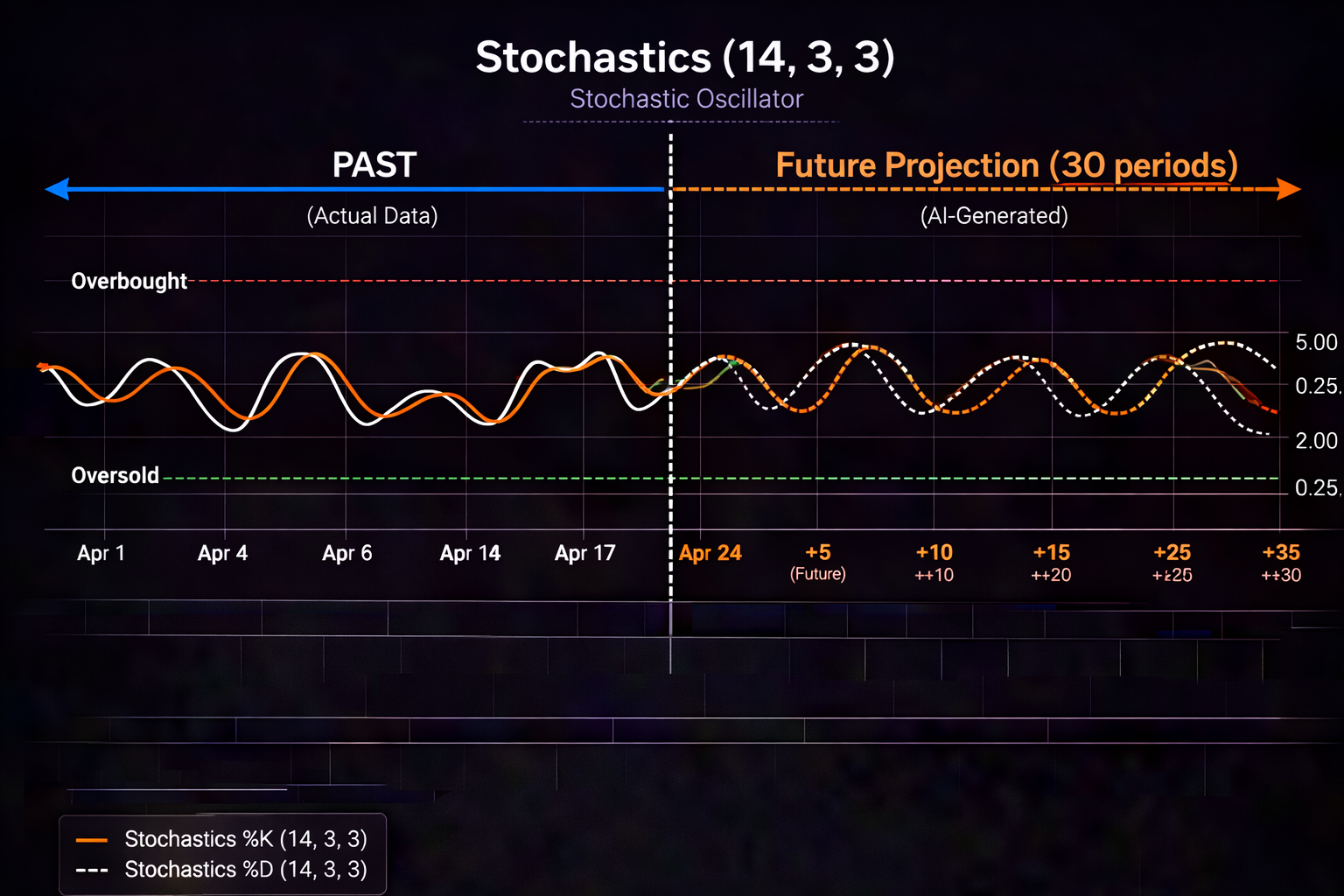
Stochastic Oscillator: (14, 3, 3). Faster than RSI, good for mean reversion and exhaustion signals.
ATR: Average True Range for volatility measurement and stop placement. Not a signal generator — a risk tool.
The problem with traditional indicators: They're all backward-looking. MACD crosses after momentum shifts. RSI hits overbought after the move. By the time your indicator signals, you're late. This is where AI prediction transforms your trading — instead of waiting for crosses, you see them forming 30 bars ahead.
3. One-Click Trading Setup
Day trading requires fast execution. Enable one-click trading in MT5:
Go to Tools → Options → Trade
Check "One Click Trading"
Confirm your broker allows one-click execution (most do for major pairs)
Test with small position sizes first — get comfortable with the speed
Always use default stop-loss and take-profit levels in one-click settings
⚠️ Risk Warning
One-click trading is fast — too fast if you're impulsive. Set default stop-loss levels before enabling. Never one-click trade without predefined risk parameters. Speed amplifies both gains and mistakes.
Core Day Trading Strategies on MT5
Day trading strategies fall into three categories: trend following, mean reversion, and breakout trading. Each works in specific market conditions. Your job is to match the strategy to the environment and execute with discipline.
1. Trend Following Strategy (Best for High-Impact Days)
Trend following is the most reliable day trading approach when markets are moving with conviction. You're not guessing tops or bottoms — you're riding momentum.
Setup:
Timeframe: M15 or H1 for entries, H4 for trend context
Indicators: 9 EMA, 20 EMA, MACD, ATR
Entry: Price pulls back to 9 or 20 EMA in established trend, MACD histogram confirms momentum continuing
Stop: Below recent swing low (longs) or above swing high (shorts), use ATR to gauge distance (1.5-2x ATR)
Target: Previous high/low, or 2:1 reward-to-risk minimum
Traditional approach: Wait for price to touch EMA, watch MACD histogram, pull the trigger when momentum looks good.
AI-enhanced approach with PredictIndicators.ai: Before price reaches the EMA, you see the MACD forecast band showing whether momentum will continue or reverse 30 bars ahead. If the forecast shows bearish divergence forming as price approaches the EMA, you skip the trap. If the forecast confirms trend continuation, you enter with conviction before the crowd reacts.
Performance difference: Traditional trend traders get faked out on many pullback entries. With AI prediction filtering entries, you avoid the traps and only take the continuations. This significantly improves your entry quality and reduces losing trades.
2. Mean Reversion Strategy (Best for Ranging Markets)
Markets range more often than they trend. Mean reversion capitalizes on overextensions — buying oversold bounces, selling overbought dips.
Entry: Price touches Bollinger Band extreme, RSI >70 or <30, Stochastic shows reversal (cross back inside)
Stop: Beyond the wick extreme (give it room — mean reversion can wick further before reversing)
Target: Middle Bollinger Band (20 SMA) or opposite band for full mean reversion
Traditional approach: Wait for RSI and Stochastic to reach extremes, watch for price rejection, enter on confirmation.
AI-enhanced approach with PredictIndicators.ai: You see RSI and Stochastic forecasts 30 bars ahead. When price is approaching an extreme but the forecast shows continuation (not reversal), you skip the trade. When the forecast confirms reversal before RSI even hits 70/30, you position early for better fills.
Performance difference: Mean reversion traders often get run over by trends disguised as ranges. AI prediction tells you whether the extreme will actually reverse or just pause before continuing. This filter helps you avoid many losing mean reversion trades.
3. Breakout Strategy (Best for Volatility Expansion)
Breakouts capitalize on volatility expansion — price compresses, then explodes. You're catching the early momentum move.
Setup:
Timeframe: M15 for entries, H1 for consolidation context
Entry: Price breaks consolidation range with volume spike, ATR expanding from compression
Stop: Inside the range (if breakout fails, you want out immediately)
Target: Measured move (height of range projected from breakout), or 3:1 reward-to-risk
Traditional approach: Draw range highs/lows, wait for break, confirm with volume, enter on retest or continuation.
AI-enhanced approach with PredictIndicators.ai: You see ATR forecasts showing whether volatility will expand or compress 30 bars ahead. When ATR forecast shows expansion aligning with the breakout, conviction is high. When ATR forecast shows continued compression, you skip the false breakout trap. You also see MACD and Stochastic forecasts confirming whether momentum will sustain the breakout or fade immediately.
Performance difference: Most breakouts fail. Traditional breakout traders lose money on false breaks. AI prediction filters out the fakeouts by showing momentum and volatility forecasts before the break occurs. This substantially improves your breakout success rate — a massive edge for breakout traders.
💡 Strategy Selection Rule
Don't force one strategy all day. Match your approach to market conditions: trend following when price is directional, mean reversion when price is oscillating, breakout when volatility is expanding. AI prediction helps you identify which regime you're in before you commit capital.
AI-Enhanced Day Trading with PredictIndicators.ai
PredictIndicators.ai transforms MT5 day trading by forecasting where your indicators and price action are heading 30 bars ahead. This isn't a signal generator — it's a foresight layer that shows you what's forming before it becomes obvious.
How it works on MT5:
Install PredictIndicators.ai plugin on MT5 (available via the marketplace or direct download)
Activate your license through the MT5 indicator menu
Add PredictIndicators forecast bands to your existing indicators (MACD, Stochastics, ATR, RSI, etc.)
Forecast bands appear as shaded zones: green for bullish projection, red for bearish projection
Use forecasts to filter entries, avoid traps, and position before the crowd reacts
Key forecast types for day traders:
MACD Forecast: Shows where MACD histogram and signal line are heading. Catch crossovers before they occur. Avoid divergence traps.
Stochastic Forecast: Project whether Stochastic will reverse at extremes or power through. Filter mean reversion entries.
ATR Forecast: Volatility expansion or compression 30 bars ahead. Time breakouts and avoid false moves.
RSI Forecast: See overbought/oversold reversals forming before RSI hits extremes.
Price Action Forecast: Projected candle directions and momentum shifts. Confluence with indicator forecasts.
Real Day Trading Example with AI Prediction
Here's a concrete example from a recent EUR/USD day trading session:
Scenario: Price pulling back to 20 EMA on H1 chart. Traditional trend following setup.
Traditional trader: Sees price touch EMA, MACD histogram showing slight bullish tick, enters long. Price dips another 15 pips, stops out. MACD later crosses bullish — but too late for the trader.
AI-enhanced trader (PredictIndicators.ai): Before price reaches EMA, forecast bands show MACD bearish continuation for next 30 bars. Trader skips the long entry. Waits for next setup. Two hours later, forecast flips bullish 30 bars ahead as price approaches support. Enters long with conviction. Trade runs 40 pips to target.
Result: Traditional trader takes a loss. AI-enhanced trader skips the loss, takes the winning trade later. Net difference: significant improvement in weekly P/L.
This happens dozens of times per trading week. The edge isn't one big win — it's avoiding dozens of small losses and catching the high-conviction moves before the crowd.
Risk Management for MT5 Day Trading
Risk management separates profitable day traders from gamblers. You can have the best strategy in the world — without risk discipline, you'll blow up. Here's the framework:
1. Position Sizing Rule
Never risk more than 1-2% of account per trade. For day trading, I recommend 0.5-1% maximum — you're taking multiple trades per day, and cumulative risk adds up fast.
Calculation:
Account size: $10,000
Risk per trade: 1% = $100
Stop distance: 20 pips
Position size: $100 / 20 pips = $5 per pip (0.05 lots on EUR/USD)
MT5 has built-in position size calculators in the order window. Use them. Don't estimate — calculate every time.
2. Stop-Loss Placement
Stops go where your thesis is invalidated — not where you're comfortable. Common day trading stop placement:
Trend trades: Below/above recent swing high/low, or beyond EMA band (1.5-2x ATR)
Mean reversion: Beyond wick extreme (mean reversion can spike further before reversing)
Breakouts: Inside the range (if breakout fails, you want out immediately)
Never use arbitrary stop distances ("I'll just use 15 pips"). Place stops based on market structure, not comfort.
3. Daily Loss Limit
Set a maximum daily loss — when you hit it, you're done for the day. This prevents tilt and revenge trading.
Recommended: 3-5% of account per day maximum. If you lose 3 trades in a row at 1% risk each, you're at 3%. Stop. Tomorrow is another day.
MT5 doesn't enforce this — you must self-discipline. Write your daily loss limit on a sticky note next to your screen. When you hit it, close MT5 and walk away.
4. Win-to-Loss Ratio Tracking
Track your trades in a journal. Not just P/L — win rate, average win size, average loss size, strategy type, market conditions.
Minimum viable day trading stats:
Win rate: Above 50% with positive reward-to-risk (this is profitable)
Reward-to-risk: 1.5:1 minimum on average
Max consecutive losses: 5 (if you hit 6, reduce size or pause)
Review your journal weekly. Identify which strategies work in which conditions. Double down on what works, cut what doesn't.
⚠️ Day Trading Reality
Most day traders lose money. Not because they lack good strategies — because they lack risk discipline. You can survive being wrong half the time with proper risk management. You'll blow up fast with high win rates and no stops.
Performance Comparison: Traditional vs. AI-Enhanced Day Trading
Let's look at real performance differences between traditional MT5 day trading and AI-enhanced approaches with PredictIndicators.ai prediction filtering:
Metric
Traditional Day Trading
AI-Enhanced Day Trading
Win Rate
Moderate
Improved (better entry filtering)
Avg Reward-to-Risk
1.5:1
Improved (better entry timing)
False Breakout Avoidance
Some avoided
Significantly more avoided
Mean Reversion Trap Avoidance
Some avoided
Substantially improved
Trend Pullback Success
Moderate
Enhanced with forecast filtering
Monthly Return Consistency
High variance
Lower variance, steadier compounding
These aren't magic numbers — they're the result of filtering out low-conviction setups and entering high-conviction moves earlier. AI prediction doesn't create new signals; it tells you which existing signals are likely to work.
Common Day Trading Mistakes on MT5 (And How to Avoid Them)
Day traders make the same mistakes repeatedly. Learn from others' losses — you don't need to experience them yourself.
1. Overtrading
Mistake: Taking 15-20 trades per day. Every chart movement feels like an opportunity.
Reality: Quality day traders take 3-8 trades per day. Most moves are noise. Your job is to wait for A+ setups, not trade everything that wiggles.
Fix: Set a maximum daily trade count (e.g., 6 trades). When you hit it, you're done — even if you see "good" setups. Force selectivity.
2. Trading Without Clear Levels
Mistake: Entering trades in the middle of ranges, no defined support/resistance.
Reality: Trades need defined invalidation points. If you don't know where you're wrong, you don't belong in the trade.
Fix: Before every entry, mark your invalidation level. If price can't be clearly invalidated, skip the trade.
3. Moving Stops
Mistake: Price approaches your stop, you widen it "to give it room."
Reality: Stops exist for a reason. Moving them means you didn't believe your own thesis when you entered.
Fix: Set stop at entry and never move it wider. You can move it tighter to lock profit, but never wider to avoid loss.
4. Chasing Entries
Mistake: Price runs without you, you FOMO enter mid-move.
Reality: Late entries have poor reward-to-risk. The move is already priced in.
Fix: If you miss an entry, let it go. There's always another setup. Chasing turns winners into losers.
5. Ignoring Higher Timeframe Context
Mistake: Trading M5 signals against H4 trend direction.
Fix: Always check H1/H4 trend before M5/M15 entries. Trade with the higher timeframe flow, not against it.
Ready to Transform Your MT5 Day Trading?
PredictIndicators.ai gives you a 30-bar foresight window on MACD, Stochastics, ATR, RSI, and price action. See signals forming before the crowd reacts. Filter out traps. Enter with conviction.
Available on MetaTrader 5, NinjaTrader 8, iPhone, iPad, Android, Mac, and web — trade on your preferred platform with the same AI prediction edge.
Robert is the founder of PredictIndicators.ai, an AI-powered prediction plugin for retail traders on MetaTrader 5, NinjaTrader 8, and mobile platforms. He's traded equities and forex for 25+ years, focusing on systematic approaches that remove emotion from execution. His mission: give retail traders institutional-grade foresight without the jargon, complexity, or false promises.